
📅 Published: December 18, 2025
The Role of AI Tool Models in Natural Language Processing
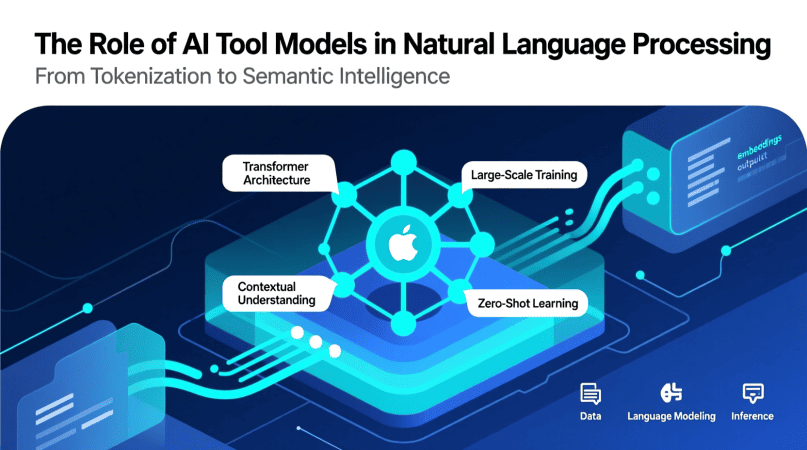
In today’s digital landscape, the ability to understand and generate human language is more crucial than ever. This is where AI tool models come into play, significantly enhancing the field of Natural Language Processing (NLP). But what exactly are these models, and how do they function?
FREE DOWNLOAD
The 2026 AI Toolkit: 30 Free Tools to Start Earning Online
Get the exact tools 6-figure AI solopreneurs use - curated, ranked, and free to start.
No spam. Unsubscribe anytime. Sent to 4,200+ US solopreneurs.
Understanding AI Tool Models
AI tool models, particularly those used in NLP, are sophisticated algorithms designed to interpret, generate, and manipulate human language. These models include a variety of architectures, ranging from traditional rule based systems to advanced neural networks.
At their core, AI tool models aim to make sense of text data, enabling machines to perform tasks that require understanding context, nuances, and semantics. The advent of deep learning has revolutionized this field, allowing models to learn from vast amounts of data.
Types of AI Tool Models in NLP
| Model Type | Description | Example |
|---|---|---|
| Rule-Based Models | Use predefined rules to process language. | Chatbots with scripted responses. |
| Statistical Models | Utilize probabilities and statistics to analyze language. | n-gram models for text prediction. |
| Neural Network Models | Employ deep learning techniques for language understanding. | Transformers like BERT and GPT. |
The Mechanics of Natural Language Processing
To truly appreciate the role of AI tool models in NLP, it’s essential to understand how they work. Here’s a step-by-step breakdown of the typical NLP process:
- Data Collection: Gather a large corpus of text data from varied sources.
- Preprocessing: Clean and prepare the data, including tokenization, stemming, and removing stop words.
- Model Training: Feed the cleaned data into an AI model to learn patterns and relationships.
- Fine-tuning: Adjust the model’s parameters for improved accuracy.
- Deployment: Integrate the model into applications for real-time language processing.
Applications of AI Tool Models in NLP
AI tool models are not just theoretical constructs; they have practical applications across various industries. Let’s explore some real-life examples of how these models are making an impact:
1. Customer Support Automation
Many companies employ AI chatbots powered by NLP models to handle customer inquiries. For instance, a leading e-commerce platform uses an AI model to analyze customer questions and provide instant responses, significantly reducing wait times and improving customer satisfaction.
2. Sentiment Analysis
Businesses utilize sentiment analysis to gauge public opinion on products or services. By analyzing social media posts and reviews through NLP models, companies can identify trends and adjust their strategies accordingly.
3. Language Translation
AI translation tools, like Google Translate, use advanced NLP models to convert text from one language to another while considering context and idiomatic expressions, improving accuracy over traditional methods.
Challenges in Natural Language Processing
Despite their capabilities, AI tool models in NLP face several challenges:
- Ambiguity: Human language is inherently ambiguous, which can confuse models.
- Context Understanding: Capturing the context behind words and phrases can be difficult.
- Bias in Data: Models can inadvertently learn biases present in their training data, leading to skewed results.
Future Trends in NLP and AI Models
The field of NLP is continually evolving, driven by advancements in AI technology. Here are some trends to watch for:
- Increased Personalization: AI models will become better at understanding individual user preferences.
- Multi-Modal Learning: Future models will integrate text, image, and audio data for richer understanding.
- Enhanced Ethical AI: Greater focus on reducing bias and ensuring fairness in AI systems.
Conclusion
The role of AI tool models in Natural Language Processing is transformative, shaping the way machines interact with human language. As these models continue to evolve, their applications will expand, leading to more sophisticated and efficient systems.
To learn more about the intricacies of AI models and how they operate, check out our detailed guide on Understanding System Prompts and AI Tool Models.
Continue Reading

Written by
George - Founder, Scalopa
George has been building AI-powered income systems since 2023. He tests AI tools hands-on and tracks real income data from 100+ US solopreneurs. All guides on Scalopa are based on direct testing or verified community data.