
📅 Last updated: May 20, 2026 | Originally published: May 8, 2026
📅 Last updated: May 2026 | 🇺🇸 Written for the US market
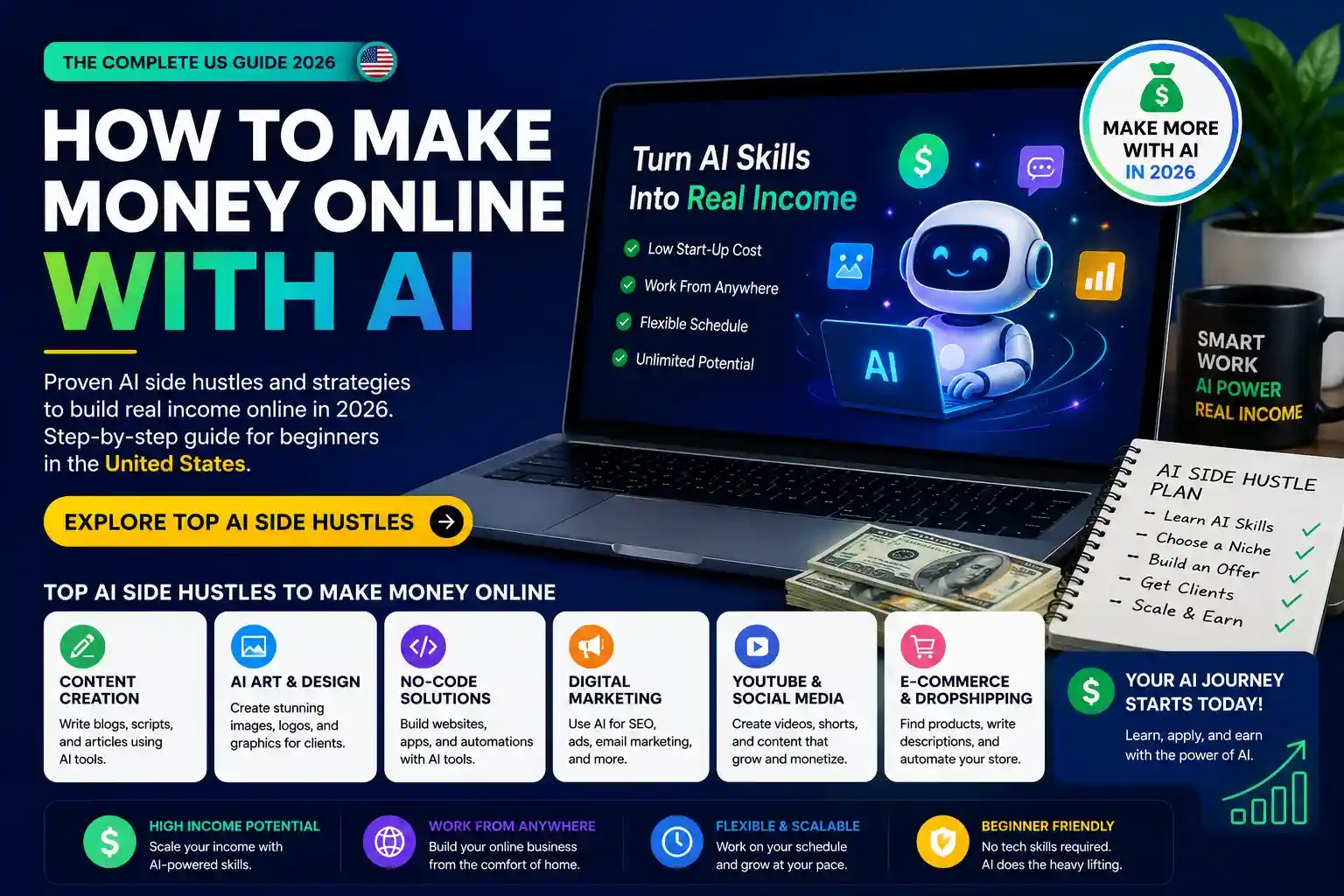
Looking to make money online with AI in 2026? You’re in the right place. Over 4.2 million Americans now report earning supplemental income using AI tools — and the number is growing fast. This guide covers the 10 best AI side hustles available right now, with real income figures, the best free tools to start, and a 7-day launch plan.
FREE DOWNLOAD
The 2026 AI Toolkit: 30 Free Tools to Start Earning Online
Get the exact tools 6-figure AI solopreneurs use - curated, ranked, and free to start.
No spam. Unsubscribe anytime. Sent to 4,200+ US solopreneurs.
Let’s get one thing straight before we dive in: AI is not a shortcut. It’s an amplifier. A mediocre approach with great tools is still mediocre. But a smart strategy with AI tools? That’s how solo operators in the US are competing with entire agencies — and winning.
The Core Shift You Need to Make: AI is not a shortcut. It’s an amplifier. The difference between someone who makes $300/month and someone who makes $3,000/month with the same tools isn’t the tools themselves — it’s the strategy behind them.
10 Best AI Side Hustles to Make Money in 2026
Here are the top-performing AI side hustles for US solopreneurs, ranked by income potential and accessibility for beginners:
1. AI Content Writing & Ghostwriting
Monthly income potential: $500 – $4,000 | Skill level: Beginner
Businesses need content at scale — blog posts, newsletters, LinkedIn articles, product descriptions. With ChatGPT, Claude, or Jasper, a skilled writer can produce 4x the output in the same time. The key is positioning yourself as a content strategist, not just a writer. You bring the brief, the research, the editing judgment — AI does the drafting. Charge $0.10–$0.25/word or $150–$500/article depending on depth.
Best platforms: Upwork, Contently, direct outreach to SaaS companies and agencies.
2. AI Automation Services (AaaS)
Monthly income potential: $1,000 – $6,000 | Skill level: Intermediate
This is the highest-value AI side hustle in 2026. Small US businesses have repetitive workflows that eat hours every week — lead syncing, content pipelines, automated reporting, invoice generation. You build these automations once using Make.com, Zapier, or n8n, and charge a monthly retainer to maintain them. No coding required — just strategic thinking and 2–3 weeks learning the platforms.
Key tools: Make.com, Zapier, n8n, Bardeen AI.
3. AI Image Design & Print-on-Demand (POD)
Monthly income potential: $300 – $2,500 | Skill level: Beginner
Midjourney, DALL·E 3, and Ideogram now produce print-ready artwork. Upload your AI-generated designs to Printify or Printful, sell through Etsy or Shopify. Zero fulfillment cost. US Etsy had over 96 million active buyers in 2024 — niche-specific designs (“nurse appreciation mugs,” “gym motivation shirts”) consistently outperform generic art because AI lets you rapidly test hundreds of variations.
Key tools: Midjourney, Ideogram, Printify, Canva.
4. Custom GPTs & AI Microtools
Monthly income potential: $1,500 – $7,000 | Skill level: Intermediate
Since OpenAI opened GPT Builder to everyone, a new market has emerged: niche AI assistants for specific professional use cases. A GPT trained to write real estate listing descriptions. A recruitment tool that generates job postings in a company’s tone. You identify the niche, build the tool, and license it repeatedly — often on a $19–$49/month freemium model. Sell on PromptBase, Gumloop, or your own Gumroad store.
5. AI Video Production (Faceless Content)
Monthly income potential: $500 – $4,000 | Skill level: Beginner
The demand for video in the US has never been higher. The faceless model: ChatGPT writes the script → ElevenLabs generates a natural voiceover → Pictory or Descript assembles the video. A 5-minute explainer video that once took a full production day can be delivered in 2–3 hours. Monthly YouTube channel management (4 videos) goes for $800–$2,000/month.
Key tools: ChatGPT, ElevenLabs, Pictory, Descript, Sora (OpenAI).
6. AI SEO & Content Strategy Consulting
Monthly income potential: $800 – $5,000 | Skill level: Intermediate
Every US business with a website wants to rank on Google. Most don’t know how. With Semrush, SurferSEO, and ChatGPT, you can deliver a comprehensive SEO audit in 48 hours that a traditional consultant would take 2 weeks to complete. One-time audits go for $150–$500; monthly retainers for $500–$2,500.
Key tools: Semrush, SurferSEO, Frase, ChatGPT.
7. AI Web Design
Monthly income potential: $500 – $3,500 | Skill level: Beginner
Wix ADI generates complete website layouts from a brief description. Framer uses AI to turn wireframes into production-ready sites. Small US businesses still pay $2,000–$10,000 for websites that take months. With AI, you can deliver in 2–3 days. That speed premium is real — clients pay for the result, not your hours.
8. AI Prompt Writing & Selling
Monthly income potential: $200 – $2,000 | Skill level: Beginner
High-quality prompts for Midjourney, ChatGPT, and Stable Diffusion sell for $3–$50 each on PromptBase. Top sellers earn $1,000–$2,000/month passively. The barrier to entry is low — but the ceiling requires understanding what professionals actually need: real estate agents, marketers, e-learning creators. Focus on professional-grade prompts, not generic ones.
9. AI Coaching & Online Courses
Monthly income potential: $1,000 – $8,000 | Skill level: Any
You don’t need to be a world-class expert to teach AI tools — you just need to be one or two steps ahead of your audience. The US e-learning market exceeded $70 billion in 2024. Tools like Heights AI generate full course outlines in hours. ChatGPT writes all your sales copy, email sequences, and lesson scripts. Host on Teachable or Kajabi. Even a $97 course sold to 100 students = $9,700.
10. AI-Assisted Freelancing (Fiverr & Upwork)
Monthly income potential: $400 – $3,000 | Skill level: Beginner
The fastest path to your first dollar with AI. Offer services on Fiverr or Upwork that you fulfill with AI assistance: logo design, resume writing, social media captions, voiceovers, business name generation, translation. The trick: use AI to deliver quality 3x faster than competitors, then reinvest that time into more clients or higher-value services.
Top services on Fiverr using AI in 2026: AI portrait editing, logo redesign, podcast show notes, LinkedIn profile writing.
2026 AI Side Hustle Income Breakdown: US Benchmarks
The following data represents realistic beginner-to-intermediate income ranges for US-based AI side hustlers, based on aggregated freelancer rate data and platform benchmarks (part-time, 10–20 hours/week):
| AI Side Hustle | Monthly Income (US) | Key Tools | Skill Level |
| AI Content Writing | $500 – $4,000 | ChatGPT, Claude, Grammarly | Beginner |
| AI Automation Services | $1,000 – $6,000 | Make.com, Zapier, n8n | Intermediate |
| AI Design & POD | $300 – $2,500 | Midjourney, Ideogram, Printify | Beginner |
| Custom GPTs / Microtools | $1,500 – $7,000 | GPT Builder, PromptBase | Intermediate |
| AI Video Production | $500 – $4,000 | ElevenLabs, Pictory, Sora | Beginner |
| AI SEO Consulting | $800 – $5,000 | Semrush, SurferSEO, Frase | Intermediate |
| AI Web Design | $500 – $3,500 | Wix ADI, Framer, Canva | Beginner |
| AI Prompt Selling | $200 – $2,000 | PromptBase, Gumroad | Beginner |
| AI Coaching / Courses | $1,000 – $8,000 | Heights AI, Teachable | Any |
| AI Freelancing (Fiverr/Upwork) | $400 – $3,000 | ChatGPT, Canva, ElevenLabs | Beginner |
Stop Guessing: Use SERP Analysis to Identify What Google Rewards
One of the biggest mistakes new AI side hustlers make is creating content or services based on what they think people want. The smartest move? Let Google tell you exactly what it wants.
SERP Analysis is the practice of deconstructing the top 10 search results to understand precisely what Google considers relevant and authoritative for a given topic. Think of it as reverse-engineering success. Instead of guessing what kind of content will rank, you look at what’s already ranking — the type (guide, listicle, video), the length, the structure, the questions answered.
Generative Engine Optimization (GEO): Winning AI Overviews and PAA Boxes
GEO is the new frontier. In 2026, Google’s AI Overviews and “People Also Ask” (PAA) boxes appear in the majority of US searches. If your content gets pulled into these features, your visibility multiplies dramatically — without necessarily being in position #1.
GEO Strategy #1 — Featured Snippets & AI Overviews: If a featured snippet exists for your target keyword, study its format (paragraph, numbered list, or table). Then structure your answer to match that exact format, answering the question concisely in your first sentence before elaborating. GEO Strategy #2 — People Also Ask (PAA) Boxes: Treat relevant PAA questions as H2 or H3 subheadings in your article. Directly below each heading, provide a clear, concise answer in 2–3 sentences.
Best Recurring Revenue AI Side Hustle Models
Most lists treat each AI opportunity as a one-time gig. The highest earners build models — repeatable, scalable systems that generate income month after month.
The Automation Expert (Highest Recurring Income Potential)
AI Automations-as-a-Service (AaaS) is the highest-value AI side hustle available in 2026. Small and mid-size US businesses have repetitive workflows that eat hours every week — lead syncing, content creation pipelines, automated social media posting, invoice generation. You design these workflows once using Make.com or n8n, they run indefinitely, and you charge a monthly retainer to maintain and optimize them.
Monetization snapshot:
- One-time workflow build: $300 – $1,500 per system
- Monthly maintenance retainer: $200 – $800/month per client
- Pre-built workflow templates on Gumroad: $49 – $299 per template
The Knowledge Amplifier (Digital Products & Coaching)
AI tools have slashed course creation time from months to weeks. Use ChatGPT to generate your curriculum, ElevenLabs for voiceovers, and Canva for visual assets. Host on Teachable or Kajabi. The e-learning market exceeded $70B in 2024 and the US share continues to grow. Even a modest $97 course sold to 100 students is $9,700 in revenue.
Free AI Tools to Start Your Side Hustle Today
You don’t need to spend money to start. Here are the best completely free AI tools for each side hustle category:
- Writing: ChatGPT (free tier), Claude (free tier), Google Gemini
- Image generation: Ideogram (free), DALL·E via ChatGPT free, Adobe Firefly
- Video: CapCut (free AI features), Canva Video, Clipchamp
- Automation: Make.com (free up to 1,000 operations/month), Zapier (free tier)
- Design: Canva Free, Adobe Express
- SEO: Google Search Console, Ubersuggest (free tier), ChatGPT for content briefs
- Voiceover: ElevenLabs (free tier — 10,000 chars/month)
👉 See our full guide: Best Free AI Tools to Make Money in 2026
From Idea to Income: Your 7-Day AI Side Hustle Launch Plan
Step 1: Choose Your Model and Validate Demand
Pick ONE hustle from the list above. Before investing significant time, validate demand by posting in relevant US communities on Reddit (r/Entrepreneur, r/freelance, r/AItools) or LinkedIn. Run a quick poll. The feedback you get will sharpen your offer faster than any course.
Step 2: Keyword Strategy — Target Long-Tail Phrases
In 2026, the highest-converting keywords are long-tail (3+ words) because they signal clarified user intent. “AI side hustles” gets broad traffic. “Best AI side hustles for beginners with no experience” gets buyers. Use Google’s autocomplete, Reddit, and ChatGPT to surface long-tail variants in your niche.
Long-Tail Keywords to Target (US Market): “how to make money with ChatGPT in the US” | “best AI side hustle ideas for beginners 2026” | “AI freelancing skills that pay well” | “make money online with AI tools no experience” | “AI automation services for small businesses”
Step 3: Build a Lightweight Portfolio in 48 Hours
You do not need paying clients to build a portfolio. Create 3–5 sample projects for fictional brands — a before-and-after blog post rewrite, a sample workflow mockup, a landing page for a fake business. Host them on Notion or Carrd (both free, both clean-looking).
Step 4: Master the Marketing Duo — ChatGPT + Canva
ChatGPT generates professional cold outreach messages, tailored proposals, and ad copy. Canva creates the visual layer: professional thumbnails, social media carousels, and brand kits. The combination of compelling copy and polished visuals creates a first impression that converts — critical in the US freelance market where clients decide in seconds.
Your 7-Day Launch Checklist
- Day 1–2: Choose your primary AI side hustle and complete SERP analysis for your target niche
- Day 3: Build 3–5 portfolio samples using fictional brands. Host on Notion or Carrd
- Day 4: Validate demand — post in 2–3 Reddit or LinkedIn communities and gather feedback
- Day 5: Create your Fiverr, Upwork, or direct outreach offer. Use ChatGPT to write all copy
- Day 6: Design 3–5 Canva visuals for your portfolio and social media presence
- Day 7: Send 10–20 personalized outreach messages. Track responses and iterate on your offer
Frequently Asked Questions About Making Money Online with AI
How much money can you realistically make with AI side hustles in 2026?
Most US beginners earn $300–$1,500/month in their first 3 months working part-time (10–15 hours/week). Intermediate practitioners with 6+ months of experience commonly report $2,000–$5,000/month. Full-time dedicated AI entrepreneurs in high-value niches (automation, consulting) routinely earn $5,000–$15,000/month. Results depend heavily on niche selection, consistency, and how well you match your offer to market demand.
Do you need coding skills to make money with AI?
No. The majority of the 10 side hustles in this guide require zero coding. Tools like Make.com, ChatGPT, Midjourney, Canva, and ElevenLabs are visual, drag-and-drop, or prompt-based. The one exception is building custom SaaS tools or advanced API integrations — but even these have no-code alternatives in 2026.
What is the fastest AI side hustle to start earning money?
AI-assisted freelancing on Fiverr or Upwork is the fastest path to your first dollar — often within 1–2 weeks of launching your profile. AI content writing and AI prompt selling on PromptBase are close seconds. Automation services and custom GPTs take longer to set up (2–4 weeks) but offer significantly higher recurring income.
Can you make money with ChatGPT alone?
Yes. ChatGPT is the most versatile AI tool for earning online. You can use it for content writing, prompt engineering, business consulting, creating how-to guides, ghostwriting for executives, writing cold outreach emails, and generating course outlines. Many solopreneurs earn $1,000–$3,000/month using ChatGPT as their primary tool, combined with Canva for visuals and a simple freelancing profile.
Are AI side hustles sustainable long-term?
The most sustainable AI side hustles in 2026 are those built around recurring revenue: automation retainers, subscription tools, and ongoing content contracts. One-off gigs (logo design, resume writing) create income but require constant client acquisition. The strategic move is to start with gigs, then package your best service into a retainer or productized offer.
What AI side hustle has the highest income ceiling?
Custom GPTs and AI microtools have the highest theoretical ceiling because they are infinitely scalable — you build once and license repeatedly. AI automation services are close behind due to recurring retainer income. Both require 1–3 months to establish but can generate $5,000–$15,000+/month for skilled practitioners. AI coaching and courses also have high ceilings once an audience is established.
Conclusion: AI Won’t Replace You — But It Will Amplify You
We’ve covered the 10 best AI side hustles in 2026, the income benchmarks, the free tools to start, and the 7-day launch plan. Here’s the summary:
Your Key Takeaways: 1. Start with SERP Analysis — let data drive your content and service decisions 2. Optimize for GEO — structure your answers so AI Overviews surface them 3. Choose a recurring income model — automation or digital products beat one-off gigs 4. Validate before you build — feedback from real US communities saves months of wasted effort 5. Master ChatGPT + Canva — the marketing duo that makes you look like a 10-person team
The US market is enormous, the demand for AI-assisted services is exploding, and the barrier to entry has never been lower. The way to stand out isn’t to shout louder — it’s to be more useful, more structured, and more strategic than everyone else in your niche.
Start with one model. Go deep. Build one content asset or service offering that’s genuinely better than everything currently ranking. Then scale.
Ready to start your AI side hustle journey? Pick one model from this guide and take your first action today.
Continue Reading
 AI Side Hustles
Real Cost of Running an AI Business in 2026 (Monthly Breakdown)
- AI Side Hustles
How Much Do AI Prompt Engineers Make in 2026? (Real Salary Data)
- AI Side Hustles
AI Freelancer Income Report: $0 to $3,000/Month in 6 Months (Full Breakdown)
- AI Side Hustles
I Made $10,000 with AI in 90 Days: Here’s Exactly How (Real Numbers)
Written by
George - Founder, Scalopa
George has been building AI-powered income systems since 2023. He tests AI tools hands-on and tracks real income data from 100+ US solopreneurs. All guides on Scalopa are based on direct testing or verified community data.