
📅 Last updated: June 8, 2026 | Originally published: May 12, 2026
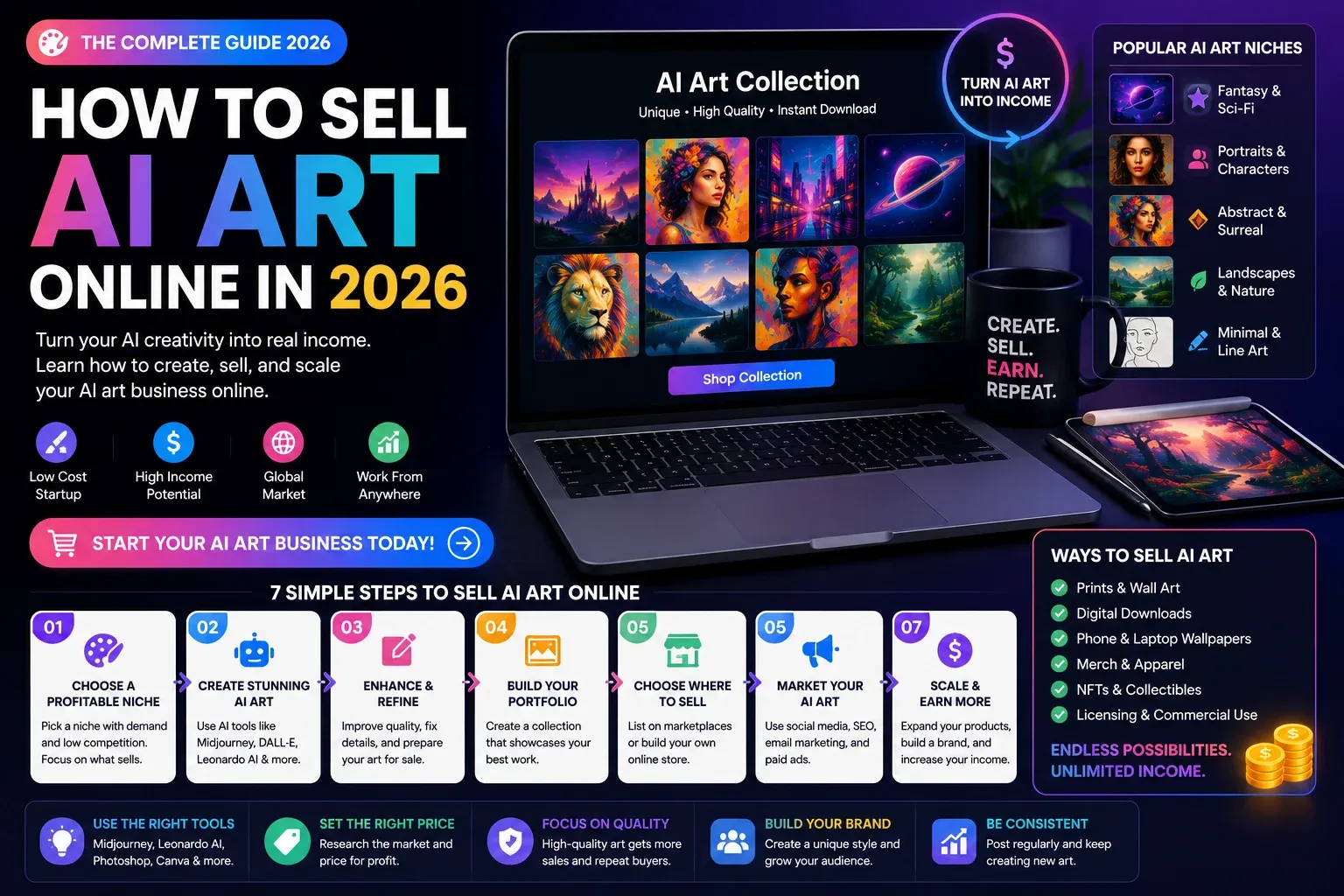
AI-generated art is generating real income on Etsy, Redbubble, Adobe Stock, and print-on-demand platforms right now. The barrier to entry is lower than at any point in history — you need a Midjourney subscription ($10/month), an account on a selling platform, and several hours to set up your first store. No design degree. No drawing ability. No inventory.
This guide covers the three most profitable channels for selling AI art in 2026 and how to make each one work.
FREE DOWNLOAD
The 2026 AI Toolkit: 30 Free Tools to Start Earning Online
Get the exact tools 6-figure AI solopreneurs use - curated, ranked, and free to start.
No spam. Unsubscribe anytime. Sent to 4,200+ US solopreneurs.
Is Selling AI Art Legal?
As of 2026, AI-generated art is legal to sell in the US. Key points:
- AI art is not automatically copyrightable in the US — the Copyright Office requires human authorship
- Most platforms (Etsy, Redbubble, Adobe Stock) allow AI art with disclosure
- Adobe Stock requires you to label AI-generated content as such
- Etsy has no blanket ban on AI art, but sellers must disclose it in listings
Channel 1: Print-on-Demand (Etsy + Redbubble)
Print-on-demand is the lowest-risk entry point. You create designs, upload them to a platform, and earn a royalty every time someone orders a product with your design — t-shirts, mugs, posters, phone cases. You hold no inventory and ship nothing.
Best Platforms
| Platform | Products | Your Cut | Audience |
|---|---|---|---|
| Redbubble | 70+ product types | 10–30% | Built-in traffic |
| Merch by Amazon | T-shirts, hoodies, PopSockets | 15–37% | Massive built-in traffic |
| Printify + Etsy | 500+ products | You set markup | Etsy buyers |
| Society6 | Art prints, home decor | 10–15% | Art-focused buyers |
How to Generate Sellable Designs with Midjourney
- For t-shirts: “minimalist vector graphic of [subject], flat design, black background, no text, clean lines, commercial use”
- For art prints: “[subject] in the style of watercolor painting, high resolution, pastel palette, fine art quality”
- For stickers: “cute cartoon [animal/character], sticker design, white outline, isolated on white background”
Generate 20–30 variations, select the best 5–8, then upscale with Topaz Photo AI for print-quality resolution.
What Sells on Print-on-Demand
- Niche hobby designs (hiking, fishing, yoga, gaming, pets)
- Funny/ironic quotes paired with illustrations
- Aesthetic patterns for phone cases and tote bags
- Seasonal designs (holidays, events)
- Profession-specific designs (nurse, teacher, engineer)
Channel 2: Etsy Digital Downloads
Selling digital art files directly on Etsy has a much higher margin than print-on-demand. The buyer pays, you deliver the file instantly, and your only cost is Etsy’s 6.5% transaction fee plus $0.20 listing fee.
What to Sell as Digital Downloads
- Wall art printables — Highest-volume category. Buyers print at home or at a local shop. Price: $3–$8 per design, $15–$25 for bundles.
- Digital planners and journal pages — Generate illustrated planner pages using AI, export as PDF. Price: $5–$25.
- Clipart and graphic element packs — Designers and teachers buy these constantly. Price: $5–$15 per pack.
- Phone wallpapers — High volume, low price ($1–$3). Sell in bulk packs.
- Coloring pages — Generate line art for adult or children’s coloring books. Price: $3–$8 per page, $10–$30 for books.
Etsy SEO for AI Art
Use all 13 available tags per listing. Include:
- Specific descriptor: “boho floral wall art” not “art print”
- Style terms: “minimalist”, “vintage”, “cottagecore”, “dark academia”
- Use case: “bedroom decor”, “office wall art”, “nursery print”
- Size: “8×10 printable”, “A4 wall art”
Channel 3: Stock Photography Licensing
Stock agencies license your AI art to businesses and marketers. You earn a royalty ($0.25–$3.00+) every time someone licenses your image. Top contributors earn $500–$5,000/month passively from large portfolios.
Platform Comparison
- Adobe Stock — Accepts AI art with disclosure. Pays 33% royalty. Highest per-download rates.
- Shutterstock — Accepts AI art labeled as such. Pays $0.10–$0.25 per download. Volume platform.
- Getty/iStock — More selective, higher per-download rates ($0.50–$5+).
What Sells on Stock Platforms
- Business and technology concepts
- Abstract backgrounds and textures
- Industry-specific illustrations (healthcare, finance, education)
- Seasonal and holiday concepts
Income Expectations by Channel
| Channel | Month 1–3 | Month 6 | Month 12 |
|---|---|---|---|
| Print-on-demand (Redbubble) | $0–$50 | $100–$400 | $300–$1,500 |
| Etsy digital downloads | $50–$200 | $300–$800 | $800–$3,000 |
| Stock licensing (Adobe) | $5–$30 | $50–$200 | $200–$1,000 |
Sellers combining all three channels with 200+ active listings consistently earn $1,500–$5,000/month by month 12.
Tools You Need
- Midjourney ($10–$30/month) — Best image quality for commercial use
- Adobe Firefly (included with Adobe CC) — Best for stock platforms due to clean commercial rights
- Topaz Photo AI ($99/year) — Upscaling to print resolution
- Canva Pro ($15/month) — Mockups, listing images, product presentation
Frequently Asked Questions
Which platform should I start with?
Start with Redbubble for zero upfront cost and built-in traffic, or Etsy digital downloads for higher margins. Stock licensing takes longer to build income but becomes the most passive of the three over time.
How many designs do I need before I see sales?
On Redbubble, most sellers see first sales around 50–100 designs. On Etsy, 20–30 strong listings with good SEO can generate consistent sales. On Adobe Stock, aim for 200+ approved images before expecting meaningful monthly income.
Continue Reading
 AI Side Hustles
Real Cost of Running an AI Business in 2026 (Monthly Breakdown)
- AI Side Hustles
How Much Do AI Prompt Engineers Make in 2026? (Real Salary Data)
- AI Side Hustles
AI Freelancer Income Report: $0 to $3,000/Month in 6 Months (Full Breakdown)
- AI Side Hustles
I Made $10,000 with AI in 90 Days: Here’s Exactly How (Real Numbers)
Written by
George - Founder, Scalopa
George has been building AI-powered income systems since 2023. He tests AI tools hands-on and tracks real income data from 100+ US solopreneurs. All guides on Scalopa are based on direct testing or verified community data.