Introduction:
The Dropshipping Opportunity in 2025
Dropshipping has become one of the most talked-about business models for aspiring online entrepreneurs — and for good reason. With zero inventory, low startup costs, and the ability to run your store from anywhere in the world, it offers a compelling path to financial independence.
But with so many voices claiming dropshipping is ‘dead’ while others swear by it, you might wonder: is it still worth it in 2025? The short answer is yes — but with important nuances.
In this guide, you will discover exactly how dropshipping works today, whether it is profitable, which niches are thriving, and how to launch your own store step by step — even if you are starting from scratch.
Key Insight: The global dropshipping market was valued at over $225 billion in 2022 and is projected to reach $1.25 trillion by 2030, growing at a CAGR of ~23%. The opportunity is not shrinking — it is evolving.
1. What Is Dropshipping? (And How Does It Work)
Dropshipping is a retail fulfillment method where you, the store owner, never hold physical inventory. Instead, when a customer places an order on your website, you purchase the item from a third-party supplier who ships it directly to the customer.
The 3-Step Dropshipping Process
1. A customer visits your online store and places an order for a product.
2. You forward the order details to your supplier (automatically or manually).
3. The supplier packages and ships the product directly to the customer — under your brand name if you wish.
You keep the difference between the retail price you charge and the wholesale price you pay the supplier. That margin is your profit.
Dropshipping vs. Traditional E-commerce
• Dropshipping: No warehouse or storage costs
• No upfront inventory investment
• Risk of lower margins and longer shipping times
• Traditional E-commerce: Full control over product quality
• Higher startup costs but typically better margins
• Faster shipping and easier branding
Pro Tip: Many successful e-commerce entrepreneurs start with dropshipping to validate their niche and product ideas before investing in inventory.
2. Is Dropshipping Still Profitable in 2025?
This is the question everyone asks — and the honest answer is: yes, dropshipping is still profitable in 2025, but the landscape has changed significantly since 2017, when it first went viral.
What Has Changed
• Competition has increased. More people know about dropshipping, which means more stores are selling similar products.
• Ad costs have risen. Facebook and Instagram ads are more expensive than they were 5 years ago.
• Customers are more sophisticated. They expect fast shipping, good branding, and responsive customer service.
• Suppliers have improved. Platforms like Zendrop, AutoDS, and DSers offer faster shipping options — including US and EU warehouses.
What Still Works
• Niche stores consistently outperform general stores in 2025.
• Branded dropshipping (your own packaging and inserts) builds customer loyalty.
• TikTok organic marketing has opened up low-cost traffic channels.
• High-ticket dropshipping (products over $300) offers better margins with fewer sales needed.
Reality Check: Most people who ‘fail’ at dropshipping chose the wrong product, relied only on paid ads, and gave up too early. Success comes from testing, iterating, and focusing on customer experience.
3. Profitable Dropshipping Niches in 2025
Choosing the right niche is arguably the most important decision you will make. A good niche has passionate buyers, repeat purchase potential, and products that solve real problems.
Top Performing Niches
• Home & Garden: Products like smart storage solutions, outdoor furniture, and kitchen gadgets continue to sell strongly.
• Pet Products: Pet owners are passionate and spend consistently. Think pet tech, grooming tools, and accessories.
• Health & Wellness: Fitness equipment, ergonomic products, and sleep aids are evergreen and highly searched.
• Baby & Kids: Parents rarely cut corners on safety and comfort — this niche has loyal repeat buyers.
• Eco-Friendly Products: Sustainable living is a growing movement with highly engaged buyers willing to pay a premium.
• Hobby & Sports: Niche sports (rock climbing, pickleball, fishing) have tight-knit communities that trust recommendations.
How to Validate a Niche Before You Start
4. Search the niche on Google Trends — is there consistent or growing interest?
5. Check Amazon bestsellers and Facebook Marketplace for demand signals.
6. Look at competitor stores using tools like Minea or AdSpy to see what is being advertised.
7. Assess the margin: can you charge at least 2-3x the supplier cost?
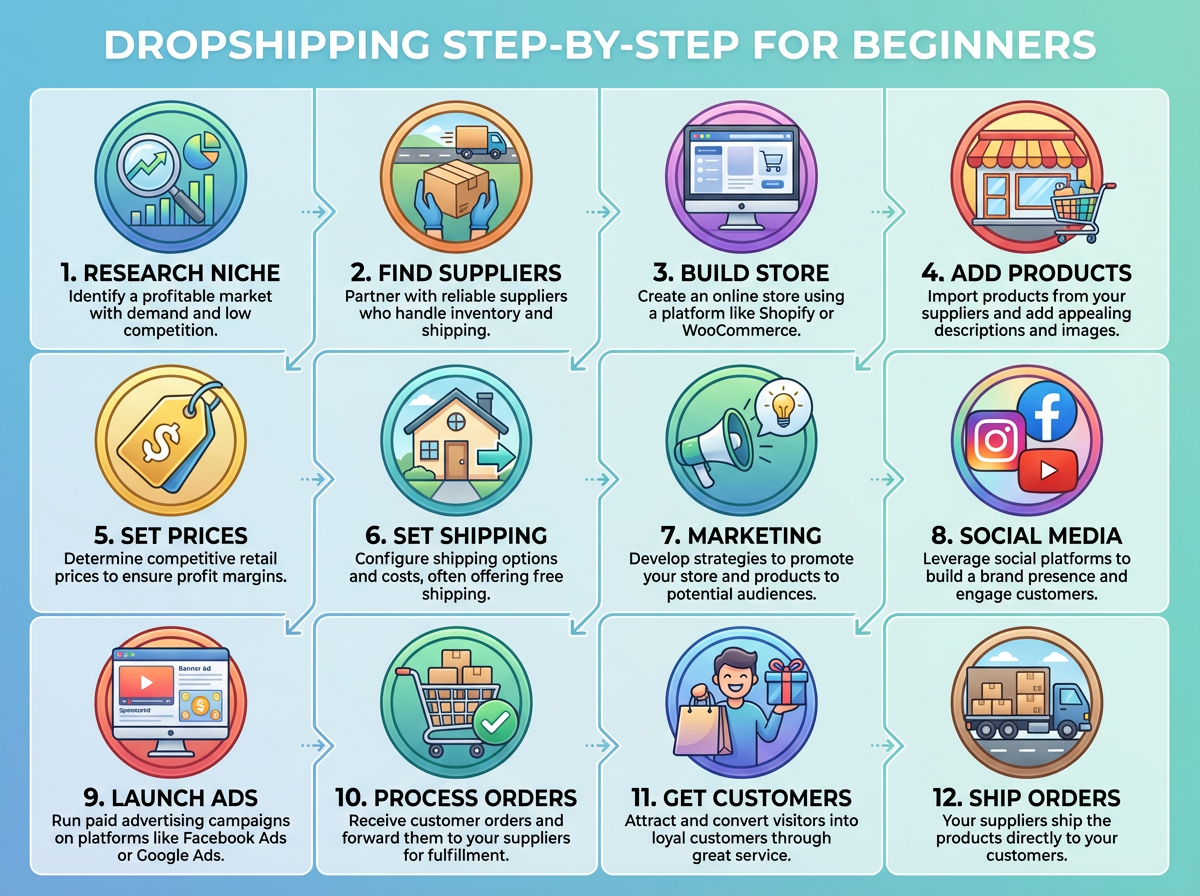
4. How to Start a Dropshipping Business: Step-by-Step
Step 1 — Choose Your Niche and Products
Begin with passion or problem-solving. The best niches are ones where customers have a specific pain point, and your product is the solution. Use tools like Google Trends, AliExpress product rankings, and TikTok to spot trending products before they peak.
Step 2 — Select a Reliable Supplier
Your supplier is your most important business partner. A bad supplier means late deliveries, poor quality, and angry customers.
• AliExpress: Best for beginners; huge selection but slower shipping.
• Zendrop: US-based fulfillment, faster delivery, great for customer satisfaction.
• Spocket: Focuses on US and EU suppliers for faster shipping.
• CJDropshipping: Good pricing with global warehouses.
• Printify / Printful: Best for print-on-demand products.
Step 3 — Build Your Online Store
Shopify remains the gold standard for dropshipping stores in 2025 due to its ease of use, app ecosystem, and reliable checkout. Alternatives include WooCommerce (for WordPress users) and Wix eCommerce.
• Choose a clean, mobile-first theme.
• Write benefit-focused product descriptions (not just specs).
• Use high-quality images — order samples to photograph them yourself if possible.
• Set up trust signals: reviews, secure payment icons, clear return policy.
Step 4 — Set Your Pricing Strategy
Your pricing needs to cover: product cost + shipping + platform fees + marketing costs + your profit margin. A common rule is to target at least 30-40% net margin after all costs.
Example: If a product costs $15 including shipping, consider selling it for $49.99. This gives you room for Facebook ads (~$10 CPA) and still clears a healthy profit.
Step 5 — Drive Traffic to Your Store
Traffic is the lifeblood of any online store. In 2025, the best channels for dropshipping include:
• TikTok Organic: Create short videos showcasing your product. Viral potential is huge at zero cost.
• TikTok Ads: Highly effective for consumer products under $100.
• Meta Ads (Facebook/Instagram): Powerful targeting; best once you have a proven product.
• Google Shopping Ads: Great for high-intent buyers searching for specific products.
• Pinterest: Excellent for home, fashion, and lifestyle niches.
• SEO and Content Marketing: Blog posts and YouTube reviews for long-term free traffic.
Step 6 — Manage Orders and Customer Service
Once orders come in, fulfillment should be largely automated through apps like DSers or AutoDS. However, customer service requires your personal attention — especially for returns, delays, and questions.
Aim to respond to all customer inquiries within 24 hours. A fast, friendly response can turn an unhappy customer into a loyal one.
Step 7 — Scale What Works
Once you find a winning product — one that generates consistent profit — the focus shifts to scaling. Increase your ad spend gradually (no more than 20-30% per day to avoid algorithm reset), expand to new markets, and introduce complementary products to increase average order value.
5. Essential Tools for Dropshipping Success
Store Platform
• Shopify ($29/month) — Best all-in-one solution.
• WooCommerce (free + hosting) — More flexible but more technical.
Product Research
• Minea — Spy on competitor ads across Facebook, TikTok, and Pinterest.
• Sell The Trend — AI-powered product research with trend tracking.
• AliExpress Dropshipping Center — Free tool to find trending products.
Supplier & Fulfillment
• DSers — AliExpress automation and order management.
• Zendrop — Fast US fulfillment with branded packaging options.
• AutoDS — All-in-one automation including price monitoring.
Marketing
• AdCreative.ai — AI-generated ad creatives with high conversion rates.
• Klaviyo — Email marketing automation for e-commerce.
• Canva — Design product images, social media posts, and ads.
6. Common Dropshipping Mistakes to Avoid
8. Choosing a product with no research — just because it looks cool does not mean it will sell.
9. Ignoring shipping times — Long delivery windows (30+ days) lead to chargebacks and bad reviews.
10. Not testing multiple products — Most successful dropshippers tested 10-20 products before finding a winner.
11. Poor customer service — This kills your reputation and leads to PayPal disputes.
12. Spending all budget on ads before validating — Test with small budgets first ($5-10/day).
13. Copying competitor stores exactly — Build your own brand identity from day one.
7. How Much Can You Realistically Earn?
Dropshipping income varies enormously based on your niche, marketing skills, and how much time you invest. Here is a realistic income breakdown:
• Beginner (0-3 months): $0 to $500/month — learning phase, testing products.
• Intermediate (3-12 months): $500 to $5,000/month — found a winning product, optimizing ads.
• Advanced (1-3 years): $5,000 to $50,000+/month — multiple products, possibly a team.
Many 6-figure dropshippers started with no business experience. What they had in common: persistence, a willingness to learn from data, and the discipline to keep testing until something worked.
Inspiration: It is not uncommon to see first-time dropshippers generate $10,000 in their first successful month once they find the right product and ad combination. But it typically takes several months of testing to get there.
8. Dropshipping Legal & Financial Basics
Business Registration
You do not need to register a business to start dropshipping, but you should as soon as you begin making consistent income. In the US, an LLC is a popular choice for liability protection. In Europe, requirements vary by country.
Taxes
You are responsible for declaring and paying taxes on your dropshipping income. In the US, if you exceed $20,000 in sales, platforms like Shopify will issue a 1099-K. Consult a tax professional once your revenue grows.
Payment Processors
Shopify Payments is the easiest option. PayPal is widely trusted by customers. Stripe is a solid alternative. Be aware that payment processors may hold funds initially for new accounts — this is normal.
Return Policy
Have a clear, fair return policy displayed prominently on your store. A 30-day return window is standard and builds customer trust. Work with your supplier to understand their return process before publishing your policy.
Conclusion: Is Dropshipping Right for You?
Dropshipping in 2025 is not a get-rich-quick scheme — but it is a legitimate, scalable business model that thousands of entrepreneurs use to generate real income. The low barrier to entry makes it an ideal starting point for anyone who wants to build an online business without large capital.
The most successful dropshippers treat it like a real business: they invest in learning, test consistently, build a brand, and prioritize customer experience above everything else.
If you are willing to put in the work, stay curious, and keep improving, dropshipping can absolutely be your path to financial freedom in 2025 and beyond.
Ready to Start? Pick one niche, find three products, set up a Shopify store, and start driving traffic. Your dropshipping journey begins with a single step.
Quick Reference: Your Dropshipping Startup Checklist
14. Choose a profitable niche using Google Trends and competitor research.
15. Find a reliable supplier on AliExpress, Zendrop, or Spocket.
16. Build your Shopify store with a clean theme and compelling product pages.
17. Set a pricing strategy targeting 30-40% net margin.
18. Launch with TikTok organic or small paid ad campaigns ($5-10/day).
19. Respond to all customer inquiries within 24 hours.
20. Analyze results weekly and double down on what works.
21. Scale winning products with increased ad spend and new markets.