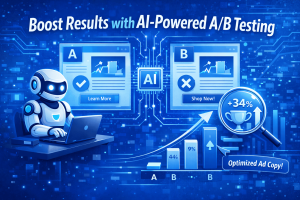
In today’s digital marketing landscape, maximizing results is more critical than ever. One of the most effective methods to achieve t is through A/B testing. But have you considered integrating artificial intelligence (AI) into your A/B testing strategies? AI-driven A/B testing is revolutionizing how businesses optimize their marketing efforts. In this article, we’ll explore how you can maximizeyour results using AI-driven A/B testing strategies.
Key Takeaways
AI enhances A/B testing with faster data analysis, deeper personalization, and predictive insights, enabling quicker, higher-impact experiments. Effective execution involves choosing the right AI-enabled tools, setting clear objectives and data-driven hypotheses, designing meaningful variations, and using AI to analyze outcomes for continuous optimization. Real-world results show substantial lifts in conversions and retention, though teams must address data privacy, algorithmic complexity, and required skills.
Before diving into AI-driven strategies, let’s first understand what A/B testing is. A/B testing, also known as split testing, involves comparing two versions of a webpage or app against each other to determine which one performs better. By showing different versions to different users, you can identify which version yields better results in terms of user engagement, conversion rates, or other key metrics.
The Importance of A/B Testing
A/B testing is essential for any business looking to optimize its online presence. It allows you to make data-driven decisions by testing hypotheses and learning what works best for your audience. This process helps in reducing guesswork, improving user experience, and ultimately increasing revenue.
The Role of AI in A/B Testing
AI brings a new dimension to traditional A/B testing by adding capabilities that were previously unimaginable. Here’s how AI can enhance your A/B testing efforts:
Faster Data Analysis
AI algorithms can analyze vast amounts of data quickly and accurately. This means you can get insights faster and make decisions more efficiently. Instead of waiting days or weeks for results, AI can provide you with real-time analysis, allowing for quicker iterations and optimizations.
Improved Personalization
With AI, you can go beyond basic A/B testing. AI can help create personalized experiences for different user segments by analyzing behavior patterns and preferences. This means you can test and implement changes that cater to individual user needs, leading to higher engagement and satisfaction.
Predictive Testing
AI can predict the outcomes of A/B tests based on historical data and current trends. This predictive capability allows you to focus on tests with the highest probability of success, saving time and resources.
Implementing AI-Driven A/B Testing Strategies
Now that we understand the benefits of AI in A/B testing, let’s explore some strategies for implementing AI-driven A/B testing in your marketing efforts.
Choosing the Right AI-Powered A/B Testing Tools
Several AI-powered A/B testing tools can help you streamline your testing process. Tools like Optimizely, VWO, and Google Optimize offer AI-driven features that can enhance your testing capabilities. When selecting a tool, consider factors such as ease of use, integration capabilities, and pricing.
Setting Clear Objectives
Before starting any A/B test, it’s crucial to define clear objectives. What do you want to achieve with your test? Are you looking to increase conversion rates, improve user engagement, or enhance customer satisfaction? Clear objectives will guide your testing process and help you measure success accurately.
Creating Hypotheses
Developing hypotheses is a fundamental step in A/B testing. Your hypotheses should be based on data and insights from previous tests or user feedback. AI can assist in generating hypotheses by identifying patterns and trends that may not be immediately apparent.
Designing Test Variations
When designing test variations, ensure they are significantly different to yield meaningful results. AI can help in creating variations by suggesting changes based on user behavior and preferences. Remember, the goal is to test changes that could have a measurable impact on your key metrics.
Analyzing and Interpreting Results
Once your tests are complete, it’s time to analyze and interpret the results. AI can automate this process by providing insights into which variations performed best and why. Use these insights to make informed decisions and apply the winning variations to your marketing strategy.
by MARIOLA GROBELSKA (https://unsplash.com/@mariolagr)
Continuous Optimization
A/B testing is not a one-time process. To maximize results, continuously optimize your strategies based on test outcomes and new data. AI can assist in this ongoing process by identifying new opportunities for testing and optimization.
Real-World Examples of AI-Driven A/B Testing Success
To illustrate the effectiveness of AI-driven A/B testing, let’s look at a few real-world examples:
Example 1: E-commerce Website
An e-commerce website used AI-driven A/B testing to optimize its product recommendations. By analyzing user behavior, AI suggested personalized recommendations that led to a 20% increase in sales conversions.
Example 2: SaaS Company
A SaaS company implemented AI-powered testing to improve its onboarding process. AI identified bottlenecks in the user journey and suggested changes that resulted in a 30% increase in user retention.
Example 3: Travel Agency
A travel agency used AI-driven A/B testing to enhance its booking process. By personalizing the user experience based on AI insights, the agency saw a 15% increase in booking rates.
Challenges and Considerations
While AI-driven A/B testing offers numerous benefits, it’s essential to be aware of potential challenges. Data privacy concerns, the complexity of AI algorithms, and the need for skilled personnel to manage AI tools are some considerations to keep in mind.
Conclusion
AI-driven A/B testing strategies are transforming how businesses optimize their marketing efforts. By leveraging AI’s capabilities, you can gain valuable insights, personalize user experiences, and ultimately maximize your results. As you embark on your AI-driven A/B testing journey, remember to choose the right tools, set clear objectives, and continuously optimize your strategies for success.
By integrating AI into your A/B testing processes, you’re not only staying ahead of the competition but also paving the way for a more data-driven and efficient marketing approach. Embrace AI-driven A/B testing today and unlock the full potential of your marketing strategies.